
How to Navigate Crisis: The 7 Phases of Crisis and What We Really Need at Each Stage
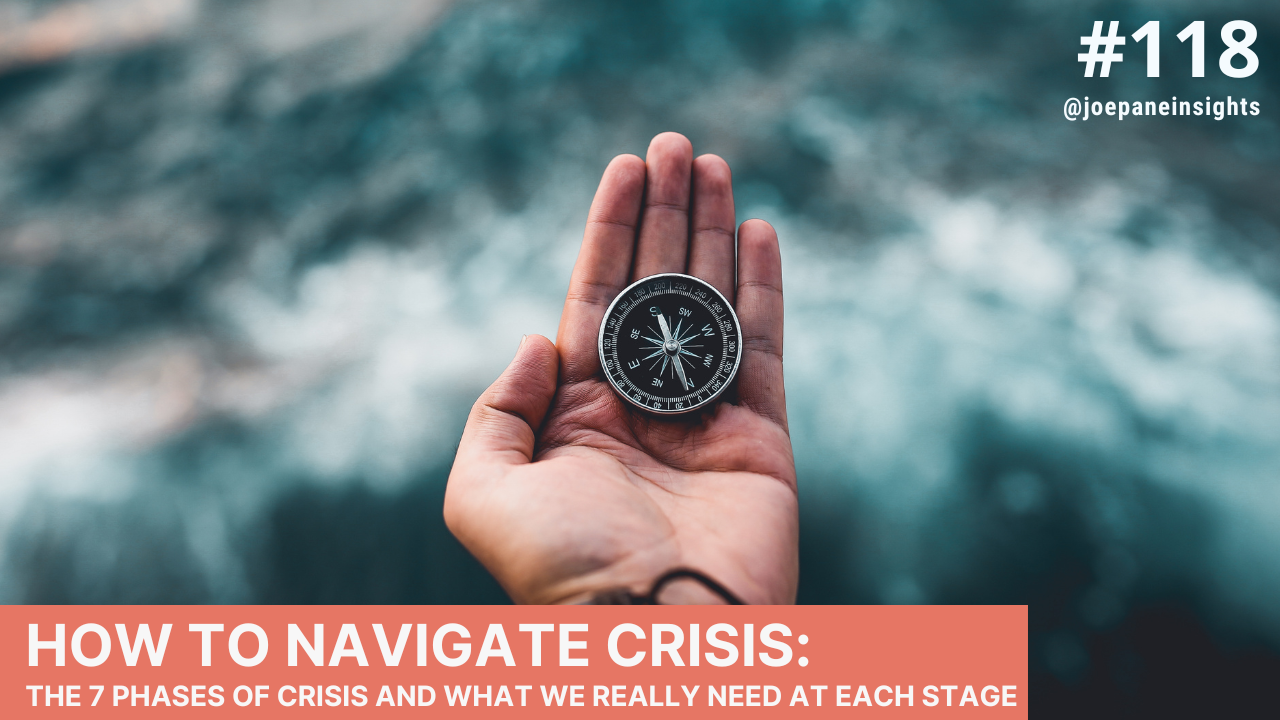
There are moments in life when uncertainty is exciting. There are moments when uncertainty is challenging. And then there are moments when uncertainty completely changes the landscape of our lives.
That is crisis.
A crisis is not simply a difficult time or a particularly bad week. From an Emotional Fitness perspective, crisis is when something we deeply care about comes to an end and we did not choose that ending. It might be the end of a relationship, the loss of someone we love, a significant change in our health, the loss of a career or business, or the sudden disappearance of a future we were certain we were going to have.
Something has changed, and there is no immediate way of putting it back the way it was.
Understanding what happens to us emotionally during these moments is incredibly important, particularly if you are a leader, coach, parent, partner or simply someone trying to support another human being through something difficult. Because one of the biggest mistakes we can make during crisis is assuming that because somebody is hurting, they need our answers.
Often, they don't.
What they need depends entirely on where they are emotionally.
And this is where understanding the Seven Phases of Crisis can make such a profound difference.
Where Crisis Sits on the Spectrum of Uncertainty
In Emotional Fitness, I talk a lot about our relationship with uncertainty. In fact, Emotional Fitness is measured by the quality of our relationship with uncertainty. But one of the important distinctions to understand is that not all uncertainty is equal.
There is uncertainty that is fun and chosen. Variety and adventure live here. Trying a new restaurant, travelling somewhere unfamiliar, doing something spontaneous or stepping into an experience where you genuinely do not know what will happen next can be uncertain, but that uncertainty is part of what makes it enjoyable.
Then there is uncertainty that is hard but chosen. Challenge lives here. Training for a marathon is a good example. Running 42.2 kilometres is hard. There is significant uncertainty involved. I don't know exactly how my body will respond on the day, but I chose the challenge. I volunteered for the uncertainty.
Then there is uncertainty that is hard and not chosen. Problems and crisis live here.
That distinction matters enormously because psychologically they require very different responses. A challenge asks something of us, but we chose to enter it. A crisis arrives without our permission and changes something we deeply care about. This is why we cannot simply treat crisis as a bigger version of a problem and immediately start searching for solutions.
Crisis creates grief.
And grief has its own rhythm.
Crisis Can Feel Like a Shattered Window
Years ago, my family and I were at home when suddenly we heard an enormous bang from another part of the house. We had a large window and somehow a stone had hit it with enough force to shatter the entire pane.
What fascinated me was that the glass hadn't actually fallen out of the frame. It was still standing there. Hundreds of cracks ran through it. The window had completely lost its structural integrity, yet somehow it remained together.
I've often thought about that image when thinking about crisis because, psychologically, that is what crisis can feel like.
From the outside, the person may still be standing. They may still be talking. They might turn up to work. They might answer their phone. They may even look remarkably composed. If you didn't know what had happened, you might think they were functioning reasonably well.
But internally, everything has changed.
The structure that once held their world together has shattered.
This is what I think of as the vulnerability point. The person is still intact, but they are incredibly fragile. And if we don't understand that, our instinct can be to rush in and start telling them what they should do next.
This is precisely where Emotional Fitness matters.
Before we offer solutions, we need to understand what is happening emotionally.
The Seven Phases of Crisis
One of the most useful things about understanding crisis is recognising that there is a pattern to it. It is not necessarily neat and it certainly isn't linear. People can move forward, backwards and revisit phases multiple times. Different people can spend very different amounts of time in each phase.
But having a framework gives us a map.
It helps us recognise when someone may need words, when they need questions, when practical support becomes useful and when the most powerful thing we can offer is simply our presence.
Phase 1: Shock and Denial
The first response to crisis is usually shock. Something has happened that the mind simply wasn't prepared for, and for a period of time the analytical part of the brain is effectively offline. Someone may hear what is being said to them, but that does not necessarily mean they can fully process it.
Denial can follow very quickly. “This can't be happening.” “I can't believe this.” “There must be some mistake.” These responses are not evidence that somebody is being irrational. They are part of the mind's attempt to process a reality that arrived too quickly.
This is why shock and denial are not the time for a motivational speech, a detailed plan or an explanation of why everything is eventually going to be okay. The person is not yet psychologically available for that conversation.
Our instinct is often to do more because we desperately want to help. But sometimes the most emotionally intelligent response is to do less. Stay close. Keep things simple. Be available. Let the reality land at the pace it needs to land.
The job is not to remove the emotion.
The job is to help someone feel safe enough to experience it.
Phase 2: Pain and Guilt
As shock begins to soften, pain starts arriving. This is when the reality of what has happened begins to register emotionally. Something that was once part of the present or future has now become part of the past, and that transition can be incredibly painful.
Sometimes guilt arrives with it.
The mind starts producing “what if” questions. What if I had noticed earlier? What if I had said something differently? What if I had made another decision? What if I had called? What if I hadn't done that?
The difficulty with these questions is that hindsight gives us access to information that we didn't necessarily possess at the time. We can end up judging a past version of ourselves using knowledge that only became available after the event.
That can create a painful illusion of control.
This is where gentle questioning can sometimes become useful. Not to talk someone out of their grief and certainly not to dismiss regret, but to help them distinguish between genuine responsibility and hindsight.
Could you really have known?
What information did you actually have at the time?
Would doing something differently genuinely have changed the outcome?
Pain is part of crisis. We don't need to add self-punishment to it.
Phase 3: Anger
Then we can reach anger.
Anger can be confronting because it is often the most outwardly visible phase. Someone may feel betrayed, frustrated, helpless or furious at another person, an organisation, themselves, life, God, the universe or simply the unfairness of what has happened.
And because anger makes other people uncomfortable, there is often a temptation to calm it down quickly.
This is also one of the worst times to start giving advice.
When somebody is deep inside anger, the analytical mind is still largely offline. You may have the most brilliant solution in the world. You may be completely correct. But that doesn't mean the person is psychologically capable of receiving it yet.
So what do we do?
We remain present.
We listen.
We allow the person to express what they need to express safely without feeling that we need to correct every statement or immediately change how they feel.
Sometimes Emotional Fitness is not knowing the right thing to say. Sometimes Emotional Fitness is having enough emotional flexibility to sit beside someone without needing them to stop feeling what they are feeling so that we can feel more comfortable.
Presence Can Be More Powerful Than Advice
I think this is one of the most important lessons in the entire framework.
When somebody we care about is suffering, our instinct is to help. And because we tend to associate helping with doing, we immediately search for something useful to say. We offer perspective. We offer solutions. We remind them of the positives. We tell them what worked for us. We start trying to construct a pathway out.
But presence is doing something.
Listening is doing something.
Sitting beside someone while their world makes absolutely no sense is doing something.
Sometimes our rush to make another person feel better is actually about relieving our own discomfort with witnessing their pain. We want them to feel better because then we will feel better too.
That's a difficult distinction to acknowledge, but it is an incredibly important one for leaders, coaches, parents, partners and friends.
Instead of asking, “How can I fix this?”, a much more useful question can be:
What does this person need from me in this phase?
That one shift changes the quality of the support we provide.
Phase 4: Depression, Sadness and Loneliness
Eventually the intensity of anger can begin to change and what often follows is sadness, depression and loneliness. Something important is now undeniably part of the past. The initial shock has passed. The anger has had its voice. And now there can be a deep awareness of what has actually been lost.
This phase is easy to misunderstand because we live in a culture that is often uncomfortable with difficult emotions. We can hear the word sadness and immediately think something needs to be fixed. We can see someone withdrawing and feel an urgency to make them happy again.
But sadness can be an entirely appropriate emotional response to loss.
If something you deeply loved is no longer there, of course you are going to feel something.
Again, the person may not need solutions. They may need availability. They need to know someone is there. They may need space without being abandoned. They may need company without conversation. They need permission to be human without being rushed towards becoming who everybody else remembers them being.
This is where emotional intelligence and Emotional Fitness become incredibly important in leadership as well. A team member going through something significant may not immediately need a productivity plan. Sometimes the most valuable leadership response is recognising the human being before the role they perform.
When the Analytical Mind Starts Coming Back Online
The first four phases are intensely emotional. Shock and denial. Pain and guilt. Anger. Depression, sadness and loneliness.
Then something begins to change.
The emotional intensity doesn't suddenly disappear. There isn't a morning where somebody wakes up and everything is magically resolved. What begins happening is much subtler.
The analytical mind starts returning.
And with it comes the beginning of possibility.
Phase 5: The Turning Point
The turning point can look remarkably ordinary from the outside.
Someone cooks a meal.
They go shopping.
They answer messages they have been ignoring.
They clean something.
They organise part of their day.
They start doing simple things they haven't felt capable of doing.
These moments can look insignificant, but psychologically they are not. They are signs that the system is beginning to stabilise and that the person is slowly re-entering life.
Reflection becomes possible again. The person may begin thinking about what happened rather than simply feeling what happened. Small decisions become possible. Small conversations can open.
This is where our support can begin to change too.
We can gently introduce questions. We can encourage manageable decisions. We can help someone regain traction without making them feel that they should already be “over it”.
They are not necessarily over anything.
They are beginning to move again.
And that is enough.
Phase 6: Reconstruction and the Identity Upgrade
This is where the crisis journey becomes particularly interesting from an Emotional Fitness perspective because recovery is not always about returning to who you were before the crisis.
Sometimes you can't.
The world has changed.
Your circumstances have changed.
Your relationships may have changed.
Your assumptions about yourself or life may have changed.
Which means a new version of you needs to emerge.
I often talk about this as an identity upgrade.
Think about the way we upgrade the operating system on our phone. The device may look similar from the outside, but internally it now has the capacity to operate differently. New functions become possible. Old functions may no longer be relevant.
Human beings go through similar upgrades.
When life changes significantly, the problems we need to solve change too. Sometimes we have no reference point for those problems because the person we were before the crisis has never had to solve them.
That can feel deeply uncertain.
But it is also where growth becomes visible.
We begin discovering capacities we didn't know we possessed. We start making decisions from a different place. Our values may become clearer. Things that once seemed incredibly important may suddenly feel less important, while simple things we once overlooked can take on enormous meaning.
We are not just rebuilding our circumstances.
We are rebuilding our relationship with ourselves.
The goal isn't necessarily to get the old you back.
The invitation may be to discover who you are becoming.
Phase 7: Acceptance and Hope
Eventually, we arrive at acceptance.
Acceptance doesn't mean liking what happened. It doesn't mean approving of it. It doesn't mean pretending there wasn't pain or wishing the experience away.
Acceptance means we are no longer fighting reality.
Something has happened. It is now part of our story. And gradually the emotional charge surrounding it begins to soften.
Memories that once created only pain can begin carrying other emotions as well. Appreciation. Gratitude. Perspective. Sometimes even warmth.
And then something very important begins appearing.
Hope.
Hope is not naive optimism. It isn't pretending everything will be wonderful. Hope is simply the recognition that despite what has happened, there can still be something meaningful ahead.
The future begins opening again.
And when hope returns, the relationship with uncertainty begins changing too. The future is still unknown, but unknown no longer automatically means threatening.
Unknown can begin to mean possibility.
The Seven Phases Are Not a Straight Line
There is something very important to remember about all of this.
Human beings do not neatly complete phase one, tick a box and permanently graduate to phase two.
We can move backwards and forwards.
Someone may experience acceptance and then suddenly find themselves angry again. A birthday arrives. An anniversary. A familiar song plays. They walk past a particular place. Someone says something unexpectedly.
Suddenly an earlier emotion returns.
That does not necessarily mean they are going backwards.
It means they are human.
The value of the Seven Phases of Crisis is not in forcing ourselves or somebody else through seven boxes. The value is awareness.
When we understand where we are, we can better understand what we may need.
And when we recognise where another person is, we can become much more useful to them.
Great Leadership Starts With Recognising the Phase
This framework has enormous implications for leadership.
Imagine someone on your team has experienced a significant crisis. If they are in shock and you immediately begin discussing performance, productivity and next steps, you may completely miss where they are psychologically.
If they are angry and you try to reason with them, your logic may never land.
If they are beginning to reconstruct their life and you continue treating them as fragile, you may unintentionally hold them inside an identity they are already beginning to outgrow.
Great leadership is not simply knowing what to say.
It is knowing when to say it.
The same applies to coaching. The same applies to parenting. The same applies to relationships.
Support needs to match the phase.
Sometimes we lead. Sometimes we ask questions. Sometimes we encourage. Sometimes we listen. And sometimes we simply sit beside someone and remind them, through our presence, that they do not have to navigate this moment alone.
That is Emotional Fitness in action.
Eventually, You Outgrow Your Past
There is one final idea about crisis that I find incredibly hopeful.
At some point, you will outgrow your past.
There are experiences that, while we are living through them, feel as though they are going to define us forever. The crisis becomes part of how we see ourselves. It can feel almost impossible to imagine a version of our life where this experience isn't sitting at the centre of everything.
Then something slowly begins to change.
We grow.
Our identity expands.
Our perspective changes.
The experience remains part of our history, but it no longer needs to be the entirety of our identity.
This is one of the most beautiful aspects of Emotional Fitness.
We are not trying to become people who never experience pain. We are not trying to eliminate uncertainty. And we certainly aren't trying to construct lives where crisis can never reach us.
That isn't life.
We are developing our capacity to navigate what life brings us without allowing every difficult experience to permanently define who we are.
Remember the shattered window?
Eventually, it needs to be rebuilt.
Not because the cracks never happened. They did.
But because something new can occupy that frame.
And perhaps that is the quiet hope inside every crisis.
One day, the thing that feels like your entire world today may become something you carry with wisdom rather than something that carries you.
You haven't forgotten it.
You've simply become bigger than it.
That is what it means to outgrow your past.
And that is Emotional Fitness.
Look forward to your insights as you read and listen to the podcast episode.
Stay connected with news and updates!
Join our mailing list to receive the latest news, VIP invites to events and updates from our team.
Don't worry, your information will not be shared.
We hate SPAM. We will never sell your information, for any reason.