
Could Your Greatest Strength Be Holding You Back? Personal Growth Through Subtraction
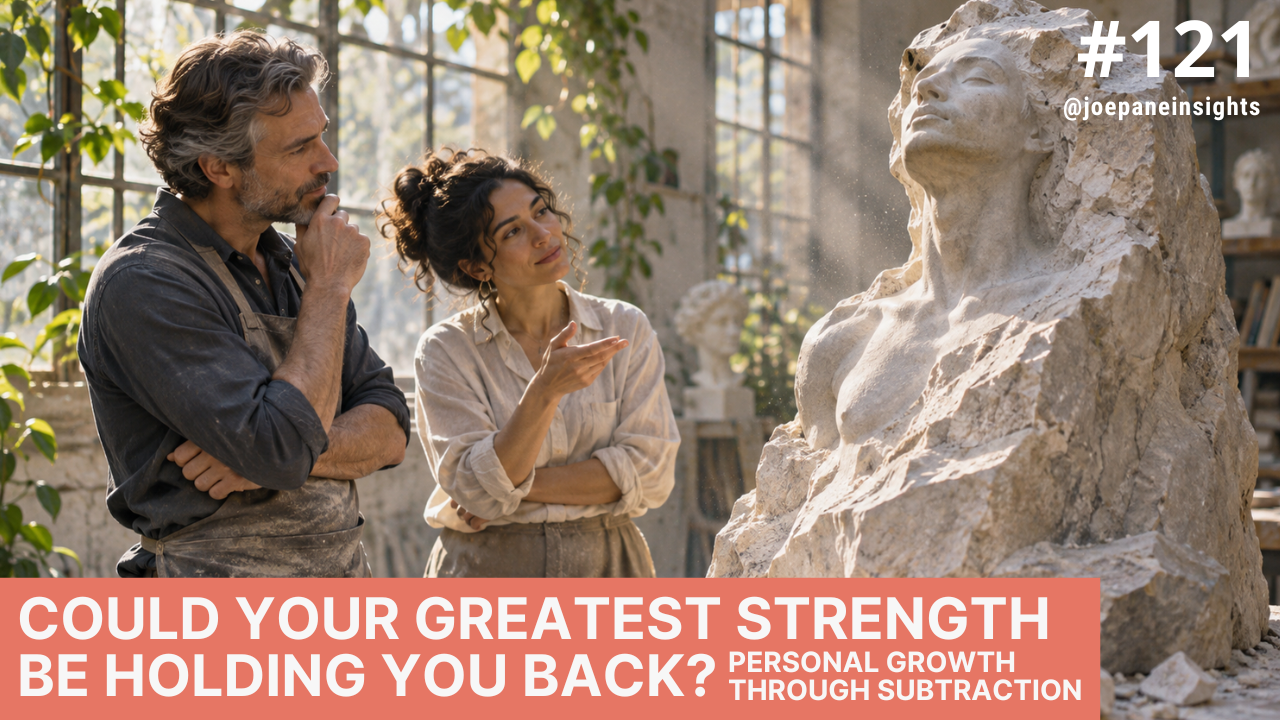
When we want to grow, we usually begin by asking what we need to add. We look for another skill, another qualification, another way to become more effective. There is value in learning, of course. I've spent much of my working life helping people understand themselves and others more deeply. But I also think there is a question we can easily overlook: what are we carrying that is making growth more difficult than it needs to be?
Sometimes we already have enough knowledge to take the next step. What gets in the way is the need to feel certain before we take it. Sometimes we know a conversation needs to happen, but we want to guarantee that the other person will approve of what we say. We keep searching for something to add when the more useful work may involve loosening a requirement we've placed on ourselves.
An idea I first heard a couple of years ago has stayed with me. It is an idea I associate with Meister Eckhart: the soul grows through subtraction. I am paraphrasing the thought here. When I first heard it, I didn't really know what to do with it. Since then, I've become interested in what it might mean for our everyday psychology, particularly the way we lead, coach and relate to people.
What does personal growth through subtraction mean?
My interpretation is that we can grow by removing some of the things that obscure our capacity to respond. Those things might be old stories, rigid expectations or beliefs that were useful at one point in our lives and have continued operating long after their purpose has changed.
Think about a sculptor working with a piece of stone. The figure takes shape through what is removed. I find that a useful image for personal development because it challenges the assumption that we are always missing something. Sometimes what we are looking for becomes more available as we stop insisting on a particular version of ourselves.
That version might be the person who always knows the answer. It might be the person who never disappoints anyone, or the person who keeps everything comfortable. These identities can feel reassuring. They can also become demanding. We start organising our behaviour around maintaining them, even when a situation calls for something else.
Subtraction, in this sense, means becoming curious about those demands. What do I believe must happen before I can speak, decide or move? Is that belief helping me respond to what is actually here?
The version of you that helped you get here
When I think about myself in 2010 and the life I am living in 2026, I can see how much has changed. That earlier version of me could not simply step into all the decisions and responsibilities I have today and handle them in exactly the same way. My capacity has had to develop. Some ways of thinking have come forward with me; others have needed to change.
I suspect many people recognise something similar when they look back over a decade. We can appreciate who we were without requiring every belief from that period to keep directing our lives. A response that helped us through one season may be too restrictive for the next.
This becomes particularly interesting when the response is something other people praise. It is relatively easy to identify a habit we dislike. It can be harder to question the quality that has earned us recognition. If people value us for being decisive, agreeable or meticulous, we may feel a subtle pressure to keep performing that quality everywhere.
When an overused strength becomes a limitation
One of the ideas I return to in behavioural profiling is this: “A strength overused becomes a weakness.” A strength can be useful and still be the wrong response to a particular moment. Its value depends partly on our ability to recognise when to use it and when to make room for something else.
A person who takes charge can bring direction to a confused situation. That same person may make it harder for others to contribute if they cannot step back. Someone who builds relationships easily can help people feel welcome. If keeping that warmth depends on never risking disapproval, important things may remain unsaid.
The growth question becomes more specific than simply asking someone to improve. Where has a useful quality become a requirement? What feels unavailable because they are so accustomed to responding in one particular way?
This is where I find the connection between subtraction and eDISC especially useful. I use the four styles as a lens for exploring familiar patterns. People are more complex than a label, and we can recognise more than one pattern in ourselves. The purpose of this conversation is to open up choices.
Four different ways to stretch beyond a familiar pattern
D energy: making room to receive help
In the broad description I use here, D energy is associated with direction, outcomes and taking charge. These qualities can help people move through challenges. The stretch comes when the person practises following, receiving help and admitting uncertainty.
Imagine being experienced and capable enough to lead a project, while also being willing to say that another person has something valuable to show you. Your ability to lead remains available. What loosens is the need to occupy that position every time.
For a leader, this can be a meaningful question: can I let someone help without feeling that my capability has been reduced? There is room to grow in the willingness to stay with that discomfort.
I energy: speaking without guaranteed approval
I energy is part of my own profile. In this conversation, I describe it through connection, people, charisma and variety. There is a great deal to appreciate there. The stretch I offer is to be quiet, disappoint someone when necessary, and speak without winning approval.
That last part is worth sitting with. Can I contribute something important when I cannot guarantee that the response will be positive? Can I listen without needing to fill the space or make the moment more comfortable?
There are times when care asks us to say something another person would rather not hear. If we need every conversation to leave us feeling liked, our honesty can become conditional. Practising a different response gives the relationship more room for truth.
S energy: allowing a little disagreement
In the broad S pattern, I am looking at steadiness, care and a preference for stability. These are valuable qualities in a team and in a relationship. People often turn towards someone steady when they feel unsettled.
The stretch I suggest is to initiate change, set boundaries and tolerate disagreement. A person can care deeply and still say that something needs to change. They can value harmony while allowing a conversation that does not immediately feel harmonious.
For example, a boundary may disappoint someone in the short term while making a working relationship more sustainable. If we treat every moment of disagreement as a sign that something has gone wrong, we can avoid the very conversation that would help us move forward. Subtraction here involves loosening the expectation that care must always feel comfortable.
C energy: moving with incomplete information
The C pattern, as I describe it in the episode, values analysis, precision and accuracy. Careful thinking matters. The growth stretch I offer is to experiment, be corrected and act with incomplete information.
Context matters here. Some decisions require rigorous checks. Other decisions allow a small, reversible experiment, yet we continue waiting as though complete certainty were available. The useful question is whether more information is genuinely needed or whether we are trying to remove every possibility of being wrong.
Receiving a correction can also be a stretch when thoroughness is central to how we see ourselves. Can we remain interested in learning when new information changes our conclusion? That willingness can make careful thinking more useful because it keeps the thinking open.
Why appreciating opposites can expand your capacity
Near the end of this conversation, I explore what I call a dialectical dilemma: holding two opposing ideas and appreciating how each might be useful. The practical value is the ability to remain flexible enough to recognise what a moment needs.
I can lead, and I can follow. I can connect warmly, and I can allow disapproval. I can create stability, and I can initiate change. I can value accuracy, and I can learn through an experiment. Both capacities can be available, even if one feels much more familiar.
This is where the idea of subtraction becomes clearer to me. We are loosening the insistence that one response must always define us. With less attachment to that insistence, another possibility can come into view. We have more room to choose.
Bringing subtraction into leadership and coaching
For leaders, a useful starting point is to notice the behaviour you reach for when a situation becomes uncertain. Do you take over, smooth things over, protect the familiar arrangement or keep looking for more information? Each response may help in some circumstances. The question is whether you can recognise when the circumstances have changed.
For coaches, I would bring curiosity to the strength a client describes with the most pride. Explore how it serves them, where it becomes costly and what they find uncomfortable about a different response. Stay with the person in front of you. Their experience is more informative than assuming a profile tells you everything.
Then find a proportionate stretch. Someone might invite a colleague's guidance before offering their own solution. Someone else might express a clear preference without apologising for it. A small experiment can reveal far more than an abstract instruction to become more flexible.
This also connects closely with Emotional Fitness. Our relationship with uncertainty shapes what we are willing to experience. A different response may involve uncertainty about another person's reaction, about our own competence or about the outcome. Becoming more willing to meet that uncertainty can make a wider choice possible.
Letting life be here while it is here
There is another part of subtraction that matters to me: recognising impermanence. As I get older, the passing of time feels increasingly real. People and experiences I once took for granted are changing. The life we have is here now, and it will continue to move.
That awareness can bring me more deeply into the experience I am having. I can spend less energy insisting that life stay exactly as it was and more energy participating in what is here. Appreciation becomes more immediate when I recognise that I cannot hold everything still.
I use a light-switch image in the episode. We turn on a light, and the room becomes easier to see. In a similar way, questioning an old story or loosening a rigid expectation can make something clearer. The opportunity may already be there; our familiar response has been obscuring it.
Before adding another demand to your own development, sit with this question: what do I keep requiring of myself that this next stage of life may no longer need?
If you would like to explore the connection between subtraction, eDISC and Emotional Fitness, join me for Episode 121 of Insights with Joe Pane, Could Your Greatest Strength Be Holding You Back? Watch or listen here:
Frequently asked questions
- What is personal growth through subtraction?
When I talk about subtraction, I mean examining the stories, expectations and automatic responses that may be narrowing our choices. Learning still matters. The additional question is whether something we already believe or repeatedly do is making it harder to use what we know. Subtraction might involve loosening a need for approval or questioning the belief that we must always have the answer.
- How can a strength become a weakness?
A strength can become limiting when we rely on it without considering what a situation needs. Taking charge can create direction, but it can also leave little space for someone else's contribution. Careful analysis can improve a decision, but continued analysis may delay a reasonable next step. I am interested in developing the flexibility to choose a response rather than depending on one familiar approach.
- How do I know what I need to let go of?
I would start by noticing repeated situations where you feel stuck, defensive or unable to respond differently. Ask what you believe you must preserve: being liked, being right, remaining in control or keeping everyone comfortable. Treat your answer as something to explore. You may discover a useful expectation, or you may find a rule that has become too rigid for your present circumstances.
- What does Meister Eckhart have to do with this episode?
I begin with an idea I associate with Meister Eckhart about the soul growing through subtraction. In the episode, I acknowledge that I am recalling the wording. My focus is the meaning I take from it and how it can inform everyday psychology. The connection to behavioural profiling is my own practical exploration of that idea, rather than a claim about Eckhart teaching a modern profiling framework.
- How does eDISC relate to personal growth?
I use eDISC as a way to explore broad behavioural preferences and the responses that may feel less familiar. In this episode, each style becomes a starting point for a different growth question. The value is in the conversation it opens up about a person's experience. A profile should leave room for context, individual differences and the possibility that someone recognises several patterns in themselves.
- What is the growth stretch for each DISC style?
In this conversation, I suggest that D energy can explore following, receiving help and admitting uncertainty. I energy can practise listening and speaking without guaranteed approval. S energy can explore initiating change, boundaries and disagreement. C energy can experiment, receive correction and make appropriate decisions with incomplete information. These are invitations to flexibility, applied with judgement to the actual situation.
- Does subtraction mean abandoning my strengths?
The practical invitation is to keep your strengths available while developing other responses. If you lead well, you can also learn from someone else. If you value accuracy, you can also recognise when an experiment is appropriate. I am interested in loosening the belief that we have to express the same quality in every moment. That can give a strength more range and usefulness.
- How can leaders apply this idea at work?
Notice the response you reach for when pressure rises, then consider what the team actually needs. There may be a moment to provide direction and another to invite guidance. A useful experiment could be asking a team member how they would approach a problem before offering your own solution. The aim is to match your response to the situation and make room for information you might otherwise miss.
- How can coaches use subtraction with clients?
I would explore the benefits and costs of a familiar behaviour with the client, using their own examples. Ask where the behaviour helps, where it creates difficulty and what makes another response uncomfortable. From there, agree on a small, relevant experiment. The client's experience should guide the work; a profiling label is a prompt for curiosity, rather than a complete account of who they are.
- How does this connect with Emotional Fitness, resilience and mental toughness?
Emotional Fitness, in my work, centres on the quality of our relationship with uncertainty. Practising a less familiar response can bring uncertainty to the surface: someone may disagree, help may be needed or an answer may be incomplete. That gives us a practical place to explore how we meet discomfort. I connect resilience and mental toughness with the capacity to respond thoughtfully when circumstances challenge us, rather than with an expectation to remain unaffected.
- What does holding opposing perspectives mean in practice?
It means recognising that two different responses can each have value. A leader can appreciate decisiveness and still see why pausing to listen matters. Someone can value harmony while recognising the need for a difficult conversation. The useful work is deciding what fits the moment. I describe this in the episode as holding a dialectical dilemma and appreciating how opposing ideas can each be applied.
- Who is Joe Pane?
I am a human behaviour expert, author, speaker, coach trainer and creator of the Emotional Fitness Formula. I have worked in human behaviour since 2006 and trained more than 30,000 coaches, leaders and consultants. Through Emotional Fitness, behavioural profiling and Insights with Joe Pane, I help people understand their patterns and explore a stronger relationship with uncertainty.
Stay connected with news and updates!
Join our mailing list to receive the latest news, VIP invites to events and updates from our team.
Don't worry, your information will not be shared.
We hate SPAM. We will never sell your information, for any reason.

