
When to Be Serious and When to Play
We spend an extraordinary amount of time trying to find balance in our lives.
Work-life balance. Family balance. Health. Relationships. Friends. Finances. Time for ourselves. Time for everybody else. There are so many priorities competing for our attention that sometimes the pursuit of balance itself becomes another source of pressure.
I've come to believe that perhaps we're trying to solve the wrong problem.
I don't know anyone who has reached this mythical place where everything at work, home and play is delicately balanced, all the plates are spinning perfectly, and every important part of life is receiving exactly the right amount of attention. Real life simply doesn't work that way. There are seasons when work needs more from us. There are seasons when family does. Sometimes our health suddenly becomes the priority. Sometimes a relationship needs more of our presence. Life moves, priorities shift and uncertainty has a habit of rearranging even our best-laid plans.
So perhaps the question isn't, "How do I perfectly balance everything?"
Perhaps a better question is, "How do I remain psychologically balanced while everything around me continues to change?"
That's where something I call the 8:80 model becomes incredibly useful.
The Only Two People You Need to Make Proud
The idea is wonderfully simple.
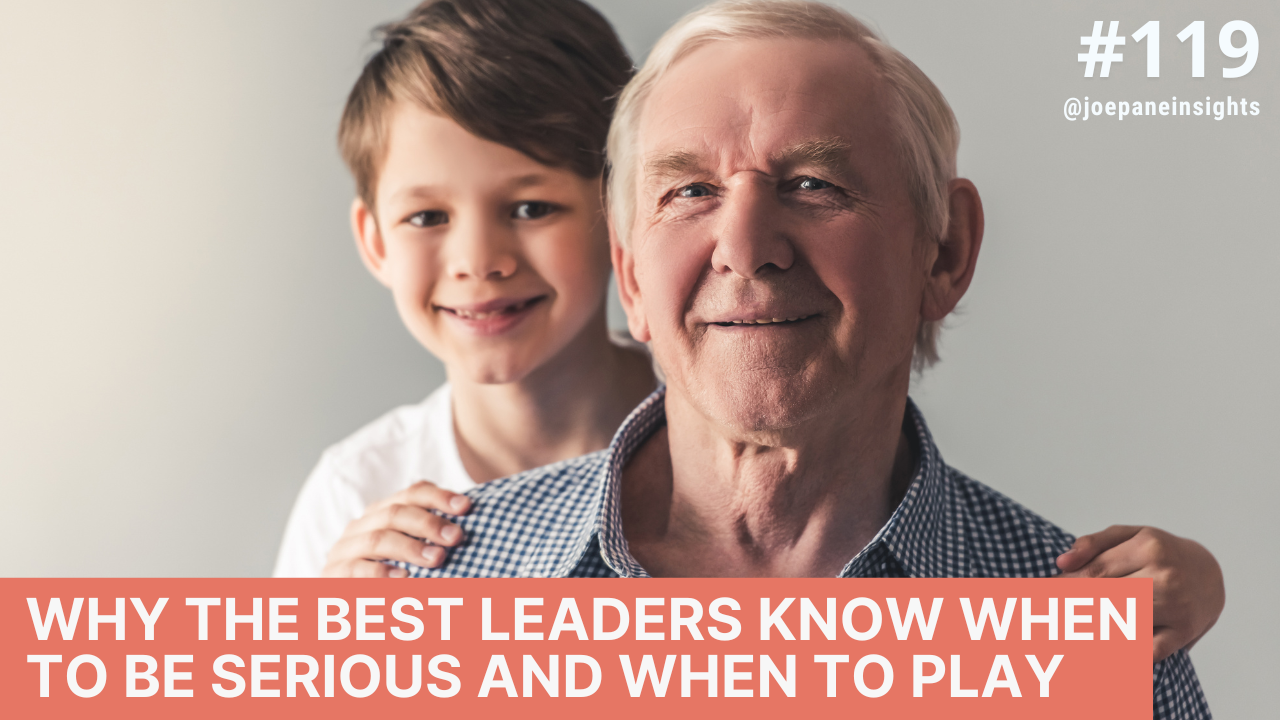
There are two versions of ourselves that I believe we need to make proud: our eight-year-old self and our eighty-year-old self.
These aren't literal ages as much as they are two psychological perspectives. They represent two very different energies that we need access to if we want to live a life with depth, joy, wisdom and meaning.
The eight-year-old represents aliveness. This is the part of us that wants to play, explore, experiment and have a go. Think about a child running around a playground. They fall over, scuff their knees, get back up and keep going. They're curious. They're interested. They're not constantly standing outside themselves wondering how everything looks to everybody else. They're immersed in the experience.
The eighty-year-old brings something completely different. This is the part of us that has perspective. Wisdom. Long-term thinking. It looks at life through a much wider lens and asks questions that the eight-year-old isn't necessarily thinking about.
What really matters here?
Who am I becoming?
Am I living well?
Am I spending this life on the things that genuinely matter to me?
One gives us aliveness. The other gives us perspective.
And I believe we need both.
The Eight-Year-Old Keeps Us Alive
Running is a big part of my life, and there have been times when I've experienced the eight-year-old part of myself very clearly through running.
I remember turning up at 5:30 on a Wednesday morning to train with a running group on a grass athletics track. There might be twenty-five or thirty of us there, and we'd start by running a few easy laps as a warm-up. You'd be chatting with whoever happened to be beside you, laughing about something, moving your body and preparing for what would eventually become quite a difficult training session.
There were mornings when I would suddenly notice how much it reminded me of being a kid.
Running around the primary school playground. Chasing balls. Kicking footballs. Hitting things with rackets. Throwing acorns at each other. Whatever it was we used to do, there was an incredible lightness to it. We weren't exercising because somebody told us it was good for our cardiovascular health. We moved because movement was fun.
That's the eight-year-old.
It's the part of us that can become suppressed under the weight of adult responsibility. As adults, we become incredibly good at being serious. We build careers. We raise families. We pay mortgages. We run businesses. We manage people. We solve problems. We meet deadlines. We become very responsible human beings.
All of that matters.
But somewhere inside all that responsibility, it's possible to develop what I jokingly call terminal seriousness.
We forget how to play.
We forget curiosity.
We forget what it feels like to do something simply because it makes us feel alive.
The eight-year-old reminds us.
Then the Eighty-Year-Old Asks a Different Question
The eighty-year-old looks at that same running session through a completely different lens.
The eight-year-old is enjoying running around the field. The eighty-year-old knows we're training for something. There is a longer-term mission. There is a reason we're putting ourselves through discomfort. There is a bigger picture.
That's what the eighty-year-old brings: perspective.
And perspective becomes particularly important because life can become incredibly noisy when we're standing too close to it. A difficult meeting can feel enormous when we're inside it. A rejection can feel incredibly personal. A setback can temporarily become the entire story.
The eighty-year-old helps us zoom out.
It asks us to look at today's problem through the perspective of an entire lifetime.
Will this matter?
What can I learn from this?
What kind of person do I want to be in this moment?
What wisdom might this experience eventually create?
That's a very different way of navigating life.
Have You Found Your Joy?
There's a beautiful scene in the movie The Bucket List that captures some of this for me.
The two main characters, played by Morgan Freeman and Jack Nicholson, are facing their own mortality. They begin travelling, having adventures and doing things they've never allowed themselves to do before. Watching it through the lens of the 8:80 model, I realised something interesting.
Their eight-year-olds are coming back to life.
Parts of themselves that had perhaps been buried beneath responsibility, routine and adulthood suddenly have permission to play again. They're exploring. They're experimenting. They're having adventures. They're doing things without needing to know exactly how they're going to turn out.
But underneath all of that play are some much deeper questions.
At one point in the movie, Morgan Freeman's character talks about two questions that, according to the story, were asked at the gates of heaven in ancient Egyptian belief.
The first is:
Have you found your joy?
I love that question.
Not: How much did you achieve?
Not: How busy were you?
Not: How impressive was your CV?
Have you found your joy?
And there are so many ways to answer that. Have you found joy in your work? In your relationships? In your marriage? In your friendships? In your family? In your adventures? In the quiet parts of your life that nobody else sees?
The second question is:
Have you been a joy for others?
That takes the conversation somewhere deeper again.
Because now we're not simply asking what life has given us. We're asking what our presence has given to other people.
How Well Are You Loving?
There are another two questions I often share in my work that sit beautifully alongside these.
How well are you loving?
And:
How well are you allowing yourself to be loved?
To me, these are some of the most important questions we can ask.
They also reveal something about courage that we don't talk about enough.
We often associate courage with achievement. Starting the business. Running the marathon. Standing on the stage. Making the difficult decision. Walking into uncertainty.
But loving somebody deeply requires enormous courage too.
I've discovered this through marriage, friendships and certainly through becoming a father. There's a saying that when you become a parent, it's as though your heart begins walking around outside your body. Your children are out there in the world and suddenly you understand vulnerability at a completely different level.
To genuinely love means becoming available to another human being.
And to allow ourselves to receive love requires vulnerability too.
The eighty-year-old understands this.
It has enough perspective to recognise that at the end of all the noise, achievement and busyness, relationships and love may matter far more than many of the things we spend our days worrying about.
Emotional Intelligence and Emotional Fitness
This is where the 8:80 model connects beautifully with emotional fitness.
I make an important distinction between emotional intelligence and emotional fitness.
Emotional intelligence is largely about awareness. It's our capacity to understand how we're feeling, why we're feeling that way and how our emotional state affects the people around us. It's also our ability to read the room, understand other people and calibrate our behaviour appropriately.
Emotional fitness is different.
Emotional fitness is preparedness for change.
It's about the quality of our relationship with uncertainty and our capacity to navigate the inevitable changes that happen across every area of life.
Plans change. Relationships change. Businesses change. Our bodies change. Children grow up. Careers evolve. People arrive and people leave. The future rarely unfolds exactly as we imagined it would.
The question isn't whether uncertainty will appear.
The question is what we have available within ourselves when it does.
This is where the eight-year-old and eighty-year-old become powerful allies.
Which Part of You Needs to Show Up?
Imagine you've just walked out of a meeting that didn't go particularly well.
The eight-year-old might say, "Okay, that didn't work. What can we try next?"
There isn't necessarily a huge emotional story attached to it. You fell over. You scuffed your knee. Get up and have another go.
The eighty-year-old brings another perspective.
"What did we learn?"
"What reference point of experience did this create?"
"Will this matter as much as it feels like it matters right now?"
"Who do I want to become through this experience?"
Neither response is necessarily better than the other.
We need both.
Sometimes we need the eight-year-old's curiosity to interrupt our overthinking. Sometimes we need the eighty-year-old's perspective to interrupt our emotional reactivity.
And sometimes the most resourceful thing we can do is invite both of them into the conversation.
Experience Becomes Wisdom
There's another relationship between these two selves that I find fascinating.
The eight-year-old creates the experiences that eventually allow the eighty-year-old to develop wisdom.
Think about it.
You travel somewhere unfamiliar. You try something you've never done before. You have the difficult conversation. You get rejected. You fall in love. You start something. You fail at something. You make a mistake. You get back up and try again.
Every one of those experiences creates another reference point.
Over time, those reference points accumulate.
And accumulated reference points become perspective.
Perspective eventually becomes wisdom.
This means wisdom isn't necessarily created by avoiding uncertainty.
In many cases, wisdom is created because we entered uncertainty.
The eight-year-old's curiosity, adventure and willingness to have a go creates the raw material from which the eighty-year-old eventually constructs wisdom.
That's a beautiful partnership.
Living Deep Rather Than Living Fast
We live in a world obsessed with speed.
Faster growth. Faster results. Faster communication. Faster technology. Faster everything.
But I'm increasingly interested in something else.
I want to live deep.
Living deeply requires presence. It asks us to notice what is happening while it is actually happening. It means loving people while they're here rather than waiting until they're gone to recognise what they meant to us. It means enjoying experiences while we're inside them rather than constantly rushing toward whatever comes next.
It means recognising joy instead of continually postponing it.
This is where the eighty-year-old gives the eight-year-old permission to come alive.
Because the eighty-year-old understands something the younger parts of us can easily forget.
Time is finite.
That doesn't need to be a depressing thought.
It can be an incredibly liberating one.
If time matters, then joy matters.
Play matters.
Love matters.
Adventure matters.
Truth matters.
The courage to be ourselves matters.
Psychological Balance Doesn't Make Life Easy
None of this means the difficult parts of life suddenly become easy.
That's not what emotional fitness is.
Emotional fitness isn't about making uncertainty comfortable, because if uncertainty were completely comfortable, it wouldn't really be uncertainty anymore.
Problems still arrive.
Crises still happen.
We still experience disappointment, loss, fear, rejection and periods where we simply don't know what's going to happen next.
Psychological balance doesn't remove the storm.
It gives us more of ourselves with which to navigate it.
I've used the metaphor before of the bison running toward a storm. Rather than running away from it and remaining inside the storm for longer, the bison moves directly toward it and through it.
That's emotional fitness.
Not pretending there isn't a storm.
Not enjoying the storm.
Having enough available within yourself to move through it.
A Simple Question to Take With You
So perhaps the next time you're facing a challenge, a difficult conversation, a decision, a new opportunity or simply an ordinary day, ask yourself two questions.
What would my eight-year-old bring to this?
Maybe it's curiosity.
Maybe it's lightness.
Maybe it's another attempt.
Maybe it's permission to stop worrying so much about what everybody else thinks.
And then ask:
What would make my eighty-year-old proud?
Maybe it's expressing your truth.
Maybe it's having the courage to love someone more openly.
Maybe it's allowing yourself to receive love.
Maybe it's choosing something meaningful over something immediately comfortable.
Maybe it's remembering what actually matters.
This, to me, is psychological balance.
Not perfectly dividing our lives into neat pieces.
Not giving equal time and energy to every priority.
Not finally reaching some mythical state where everything is under control.
It's learning to bring the right part of ourselves forward at the right time.
There is an eight-year-old inside us asking:
Are we still playing?
And there is an eighty-year-old asking:
Are we living well?
The goal isn't to choose between them.
It's to make them both proud.
Because when play meets wisdom, curiosity meets perspective, adventure meets meaning and aliveness meets depth, perhaps we stop trying so hard to live a perfectly balanced life.
And start living a deeply meaningful one.
A Final Reflection
There is an eight-year-old inside us asking:
Are we still playing?
And there is an eighty-year-old asking:
Are we living well?
The goal isn't to choose between them. It's to make them both proud.
Because when play meets wisdom, curiosity meets perspective, adventure meets meaning and aliveness meets depth, perhaps we stop trying so hard to live a perfectly balanced life and start living a deeply meaningful one.
And ultimately, that's what so much of my work in emotional fitness comes back to. We cannot control all the uncertainty that enters our lives, but we can strengthen our capacity to meet it. We can become more aware of our patterns, more flexible in our responses and more courageous in the way we move through change, challenge, problems and crisis.
Psychological balance isn't about always feeling balanced.
It's about having more of yourself available when life isn't.
Stay connected with news and updates!
Join our mailing list to receive the latest news, VIP invites to events and updates from our team.
Don't worry, your information will not be shared.
We hate SPAM. We will never sell your information, for any reason.