
Why Comfort Might Be Limiting Your Potential
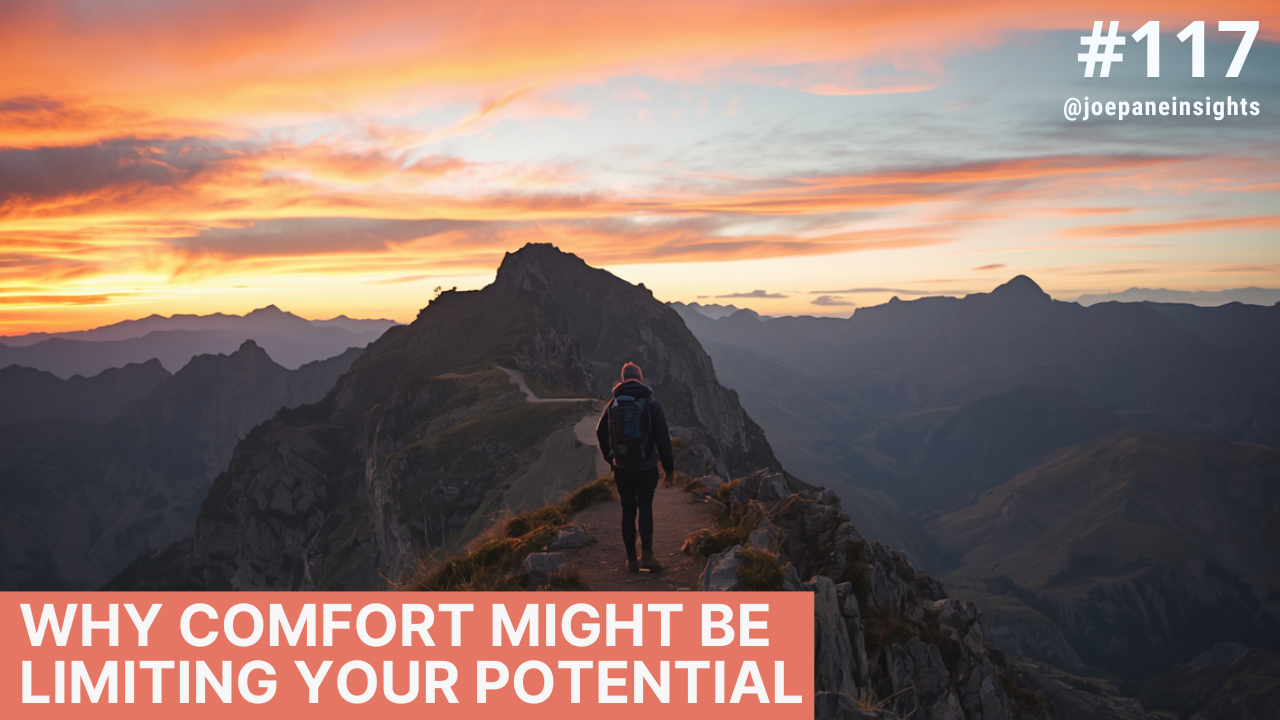
What if comfort is not the destination?
There is a quote from George Lucas that I came across recently, and it stopped me in my tracks. He said, “We all live in a cage with the door wide open.” I found that deeply confronting, not because it is harsh, but because it is true in a way that is difficult to ignore.
Now, I am not suggesting that every part of our life is a cage. That would be far too simplistic. But I do think most of us have at least one area of life where the door has been open for quite some time, and yet we keep behaving as if we are trapped. We do not step through, not because we cannot, but because something in our history has convinced us that we should not, must not, or are not able to.
This is where emotional fitness becomes so important. Emotional fitness is about transforming our relationship with uncertainty. It is not about becoming fearless. It is not about never feeling uncomfortable. It is about learning how to relate differently to the unknown, to challenge, to change, and to the parts of our life that ask us to grow beyond our familiar self.
One of the most important ideas I explored in this episode is this: comfort is not the goal. Comfort is the reward.
That one distinction changes everything.
The open cage we forget to walk out of
Most people, understandably, are trying to create more comfort in their lives. More certainty. More security. More safety. More predictability. There is nothing wrong with that. We all need a base layer of certainty in order to function well. A life with no security at all would be exhausting. We need stability. We need safety. We need a place to land.
But when comfort becomes the goal, something interesting happens. We begin to organise our lives around avoiding discomfort. We make decisions based on what will keep us safe, rather than what will help us grow. We choose the familiar path, even when it is no longer fulfilling. We protect ourselves from uncertainty, but in doing so, we can also protect ourselves from possibility.
This is the open cage. The door is not locked. In many cases, the door is wide open. But if our identity has been shaped around the belief that we cannot leave, we may not even think to test the door.
The invisible wall of past conditioning
This reminds me of the story of the northern pike fish. In an experiment, a northern pike was placed in a large tank with a clear wall separating it from its food. The fish repeatedly tried to swim through the barrier and kept hitting the invisible wall. After several days, it stopped trying. Eventually, the barrier was removed, and the food was placed right in front of it. But the fish did not move toward it. It had been conditioned to believe the wall was still there.
That story is confronting because it is not really about the fish. It is about us.
How many invisible walls do we still obey?
How many assumptions are we living by that were formed during a time when they may have been useful, but are no longer true?
A belief is often nothing more than a convenient assumption. Something we have assumed to be true because it made sense at a particular time. The challenge is that our nervous system, our ego, our identity, and our habits can continue to operate from those assumptions long after the wall has disappeared.
Build your future on your potential, not your past.
This is why I love the idea that we need to build our future on our potential, not our past.
Our past has contributed everything it can contribute. It has given us lessons. It has shaped us. It has given us experience, wisdom, scars, perspective and insight. We do not need to reject the past. But we do need to stop asking the past to define the ceiling of our future.
There is a big difference between looking at the past and staring at it.
Looking at the past can give us wisdom. Staring at the past can keep us stuck.
When we stare at the past, we begin to build identity around it. We say things like, “This is just who I am,” when often what we really mean is, “This is who I became in response to what happened.” That is not the same thing.
The future does not need to be a repetition of the most familiar parts of our history. We can decide differently. And the word decide is a very powerful word. To decide is to cut off from other possibilities. It is to draw a line. It is to say, “I am no longer building my future purely from the evidence of my past. I am building it from the potential that is calling me forward.”
Why comfort as a goal can quietly limit us
This is not always comfortable. In fact, it rarely is.
And that is exactly why comfort cannot be the goal.
If comfort is the goal, we will keep retreating whenever life asks us to grow. But if comfort is the reward, then discomfort becomes part of the path. It becomes meaningful. It becomes something we move through, not something we interpret as a sign to stop.
All meaning in life comes from contrast. We know hot because we know cold. We know light because we know dark. We know rest because we know effort. We know relief because we have experienced tension. We know comfort more deeply when we have moved through discomfort.
The power of contrast
I experienced this in a very simple and very real way during my recent half marathon. It was my 30th half marathon, and I was using it as preparation for a full marathon. The race did not go to plan. At around the halfway mark, my legs began to fatigue far earlier than expected. In running language, I blew up. Not literally, of course, but physically and emotionally, the plan began to fall apart.
There was disappointment. There was discomfort. There was frustration. And there was also a choice.
I could obsess over why it was happening, or I could stay present enough to move through what was happening. One thing running and life have both taught me is that sometimes trying to analyse every failure to the nth degree only creates more confusion. The body is complex. Life is complex. Sometimes things simply do not go to plan.
The reward waiting on the other side
In those final kilometres, what helped me was not the idea of comfort as an escape. It was comfort as a reward.
I pictured finishing the race, taking my shoes off, and walking barefoot on the grass. Such a simple image. Nothing dramatic. Nothing expensive. Nothing impressive. Just bare feet on grass.
Later, I pictured a burger and a beer. Again, simple. Ordinary. Human.
But because of the contrast, those simple comforts became deeply meaningful. The discomfort gave them depth. The effort gave them texture. The challenge gave them significance.
This is the power of contrast.
If I walked barefoot on grass every moment of every day, would it feel the same? Probably not. If I had burgers and beers constantly, would they have the same reward value? Of course not. Without contrast, comfort becomes dull. With contrast, comfort becomes alive.
What leaders can learn from discomfort
This is true in leadership as well. Leaders often want more certainty before they act. They want the perfect plan, the perfect conditions, the perfect confidence. But leadership is not built in perfect conditions. Leadership is built in the moments where we move through uncertainty with enough clarity to take the next meaningful step.
The difficult conversation. The decision that requires courage. The new standard that may not be popular at first. The willingness to step into uncertainty before every answer is available.
This is where emotional fitness becomes more than a personal development concept. It becomes a leadership capacity.
The more emotionally fit we become, the more uncertainty we can hold without collapsing into avoidance, control or procrastination.
What coaches and consultants can take from this
The same is true for coaches and consultants. The work of helping others transform requires us to understand our own invisible walls. If we are still living inside assumptions we have not questioned, we can unconsciously invite our clients to do the same. Our ability to help others expand is connected to our willingness to expand.
If I am helping someone move beyond limitation, I must be willing to look at where I am still limiting myself.
If I am helping someone transform their relationship with uncertainty, I must be willing to meet uncertainty in my own life.
If I am inviting someone to build their future on potential, I must also be willing to stop building mine purely on history.
Self trust is built after the hard thing
And this is true in personal growth too. Self trust is not built by thinking about doing hard things. It is built by following through. Every time we do something difficult and get to the other side, we send a message to ourselves: “I can trust myself.”
That is one of the deepest rewards of making comfort the reward instead of the goal. We do not just get the comfort. We get the self respect that comes from earning it.
There is a subtle psychological tuning that happens when we live this way. It is like tuning a radio. If the frequency is slightly off, all we hear is static. But when the frequency is clear, the music comes through. Small shifts in focus can make a massive difference to how we experience our life.
Tuning into life with more clarity
When we shift from avoiding discomfort to moving through it with intention, our frequency changes. Life begins to feel more meaningful. Simple things become richer. Sitting down after effort feels beautiful. A quiet coffee after a hard conversation feels grounding. A walk under a tree after a difficult meeting feels like medicine.
The best things in life are often simple, but they are rarely felt deeply without contrast.
So the practical invitation is this. Ask yourself where comfort has become the goal. Where are you organising your life around avoiding discomfort? Where are you waiting to feel certain before you move? Where are you still behaving as if a wall is there, even though it may have been removed long ago?
Then ask a better question: What comfort could become the reward?
It does not need to be grand. In fact, the simpler the better. A walk. A coffee. A quiet hour. A meal. A rest. A moment of stillness. A deep breath. A swim. A conversation. A chair under a tree.
Comfort as a reward gives the hard thing somewhere to land.
A practical reflection
If this idea resonates, here are a few questions worth sitting with:
- Where in my life have I made comfort the goal?
- What discomfort am I avoiding that may actually be part of my growth?
- What invisible wall am I still obeying?
- What would it look like to build my future on potential, not history?
- What simple comfort could I use as a meaningful reward after doing the hard thing?
These questions are not designed to create pressure. They are designed to create awareness. And awareness is often the first doorway out of the cage.
Final reflection
This is one of the many pathways into emotional fitness. The more emotionally fit we become, the more we can handle. The more we can handle, the more we manifest what we want in life. Not because uncertainty disappears, but because our relationship with it changes.
Maybe the cage door has been open for some time.
Maybe the wall is no longer there.
Maybe the next version of your life is not waiting for more comfort.
Maybe it is waiting for you to walk through the open door, do the hard thing, and let comfort meet you on the other side.
Comfort is not the goal.
Comfort is the reward.
Thank you for reading.
Check out the upcoming free events https://www.joepane.com.au/
Stay connected with news and updates!
Join our mailing list to receive the latest news, VIP invites to events and updates from our team.
Don't worry, your information will not be shared.
We hate SPAM. We will never sell your information, for any reason.